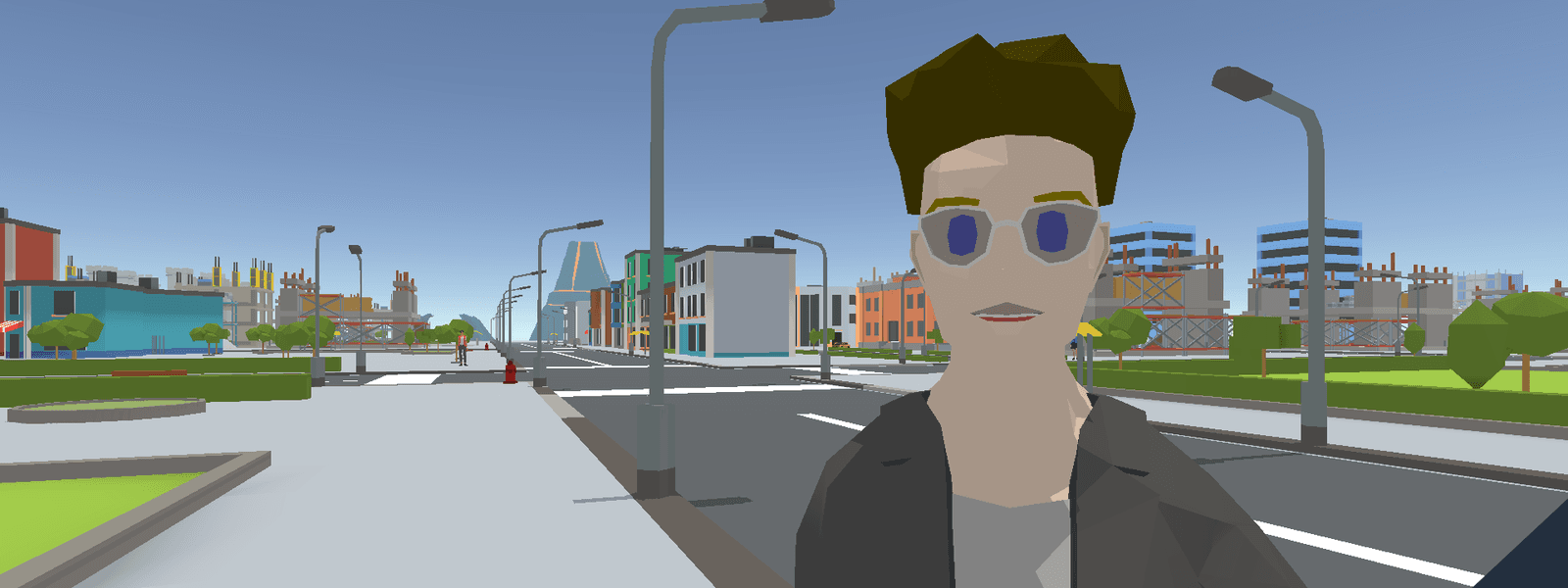
My AWS Cloud Practitioner certification was coming up for renewal. Instead of booking the exam, I spent three evenings as a cartoon person in a cartoon city.
That's AWS Cloud Quest: Recertify Cloud Practitioner. You get an avatar, a low-poly town with quietly broken infrastructure, and eleven assignments that each drop you into a real AWS console with a real problem — compute, networking, storage, databases, security, cost. Finish them all and the three-year clock resets. No exam centre, no proctor watching me not blink.
I expected to be bored. I design AI architecture and agentic workflows for a living; over the last year I've written far more specs about VPCs than I've built. What I got instead was an uncomfortable audit of the gap between explaining infrastructure and doing it.
The format is better than it looks
Every assignment opens the same way: a Solution Request in plain business language, a list of practice lab goals, and then a DIY goal you have to work out on your own.
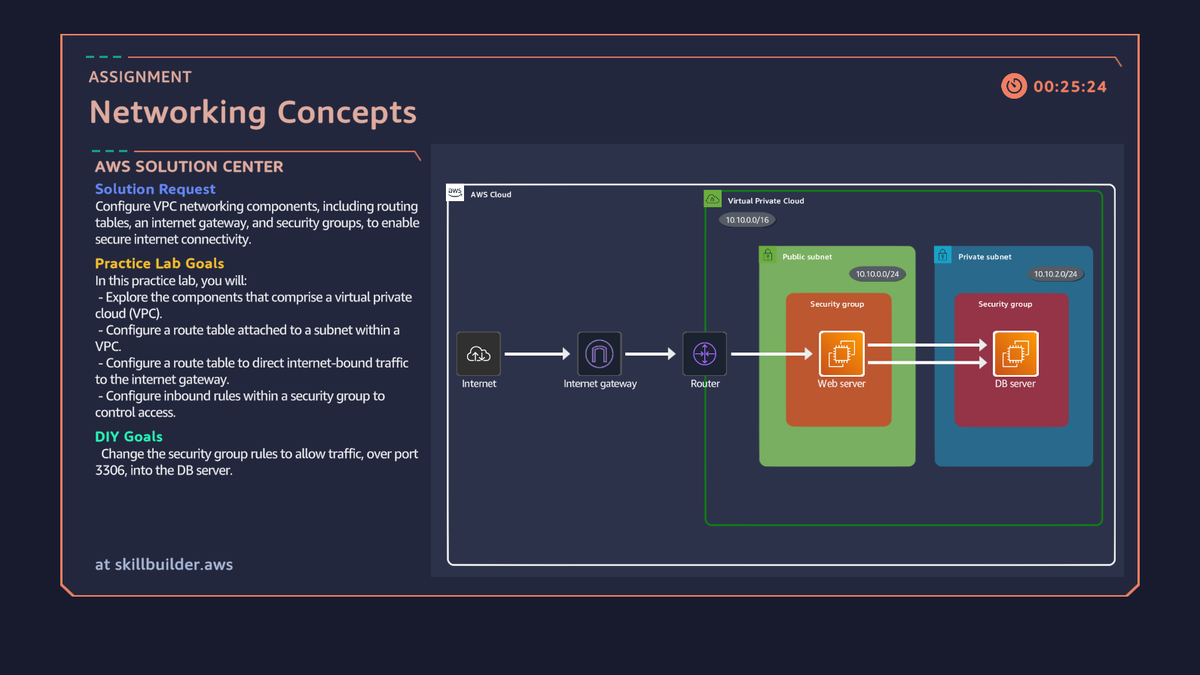
The practice half is guided — click here, then here. The DIY half is not. "Change the security group rules to allow traffic, over port 3306, into the DB server" arrives with no steps at all. That two-tier structure is the entire design: teach the motion, remove the rails, then check whether anything actually landed.
Where it caught me
Connecting VPCs. The lab walks you through one peering connection, Marketing to Finance. The DIY goal then asks for a second one, Developer to Finance.
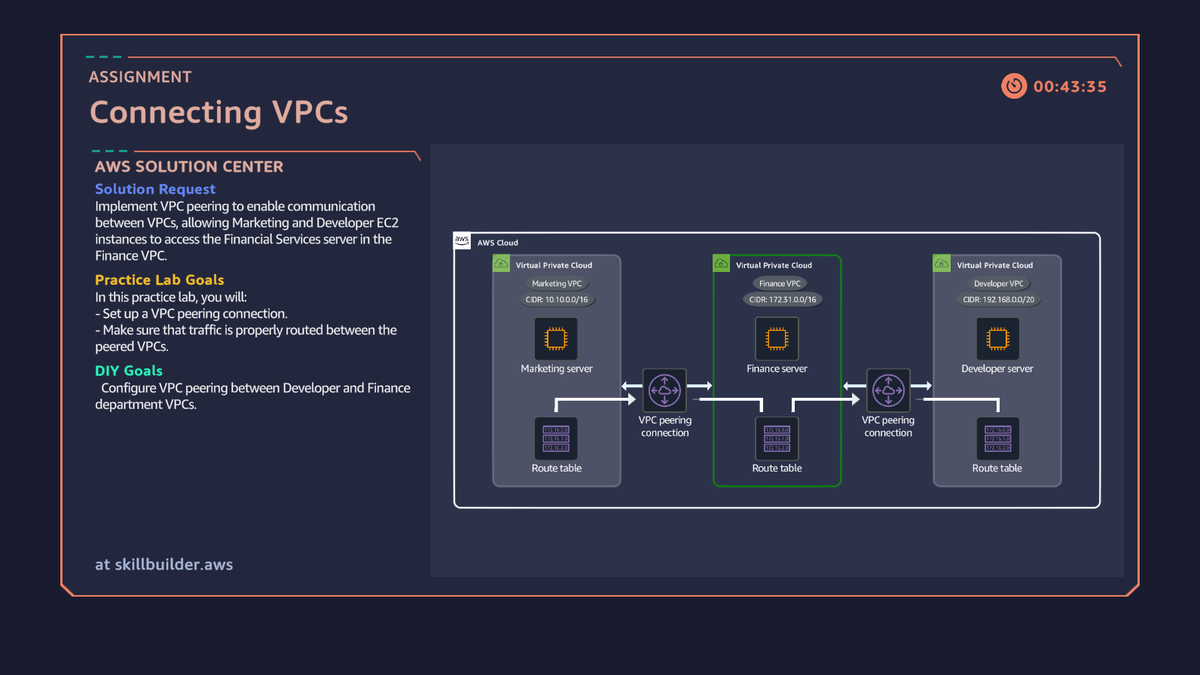
I knew VPC peering isn't transitive, in the way you know things you've read. Knowing it and having to sit there adding the second route table entry yourself are different experiences, and only one of them sticks.
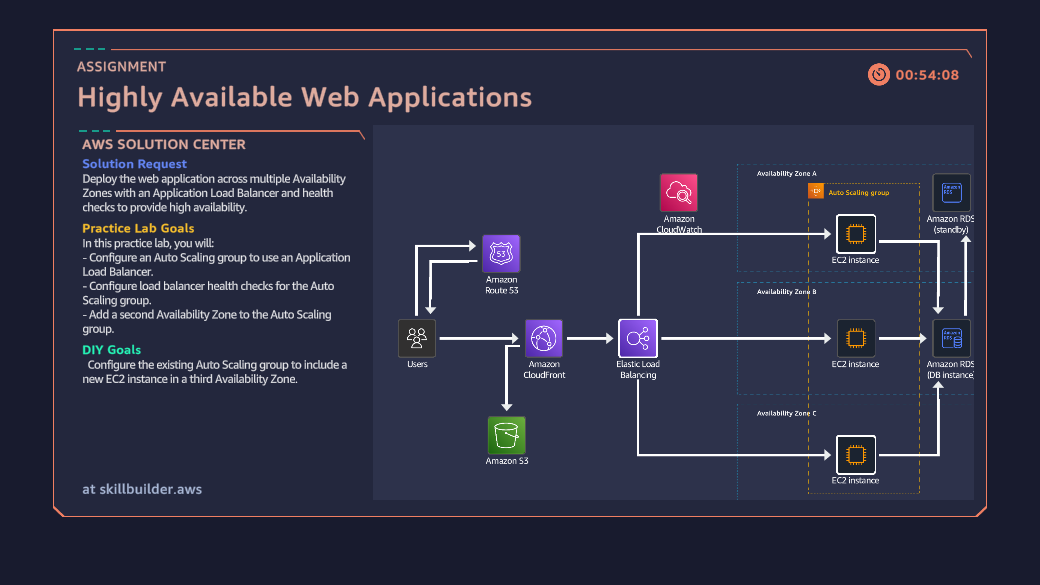
Same story with Highly Available Web Applications: point an Auto Scaling group at an Application Load Balancer, wire up health checks, add a second Availability Zone. Then the DIY goal wants a third one.
None of this is hard. That isn't the point. The point is I hadn't done it by hand in a long time, because for two years my instinct on a task like this has been to describe it and review what comes back.
The one that felt like the job
The last assignment is a challenge lab: Modernize a Cloud Architecture. Six tasks, no walkthrough at all. Enable Multi-AZ on the RDS database. Open MySQL from the app tier. Create a DynamoDB table for activity logging. Accept a VPC peering connection and fix the routing. Spread the Auto Scaling group across two AZs. Grant the application role read access to DynamoDB. Then you press Validate and it grades you.
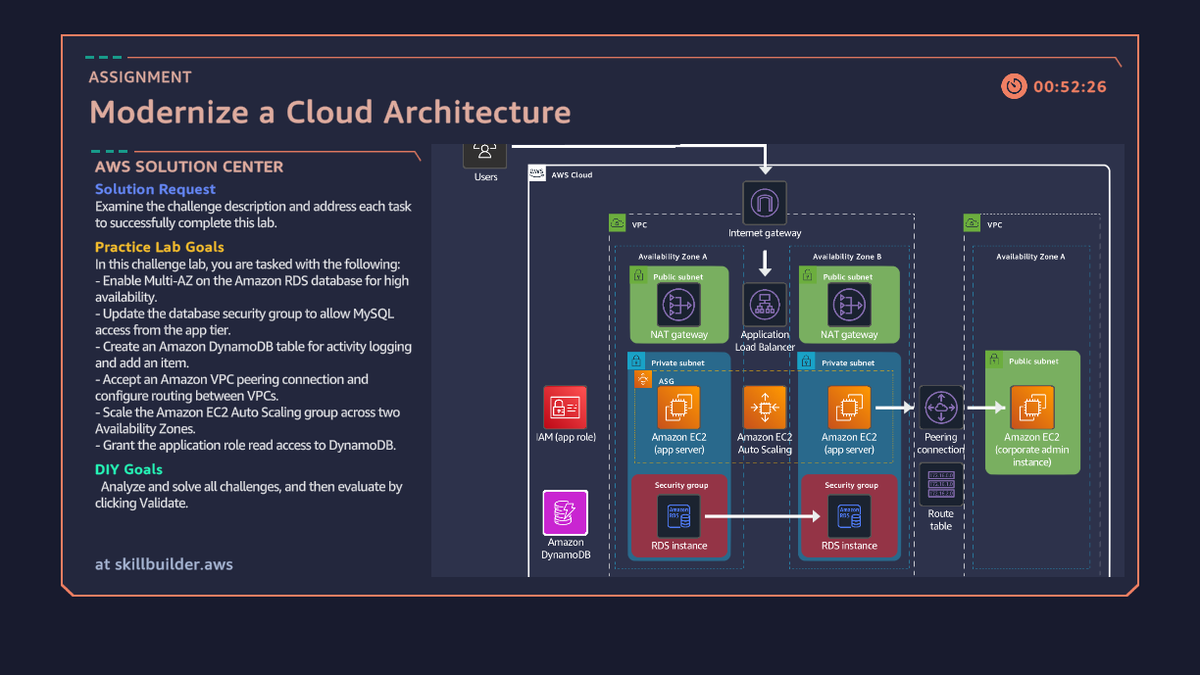
That's the only one that resembles what I actually do. Not follow these steps but here is a system with six things wrong with it, and nobody is going to tell you what order to fix them in.
What I'd tell another senior engineer
The argument for a multiple-choice recert is that it's fast. The argument for this one is that it's the right shape.
Here's what fundamentals are actually for in 2026. I don't need to remember the click path to create a route table. I need to look at a plan an agent produced, notice it created the peering connection and stopped, and know the routes are missing before anything gets applied. That isn't recall. That's review — and review only works on primitives you've handled at least once yourself.
Recertifying by clicking is slower than recertifying by answering. It also left me with something the exam wouldn't have: a short, honest list of the primitives I'd quietly stopped being able to check.
Worth three evenings.